
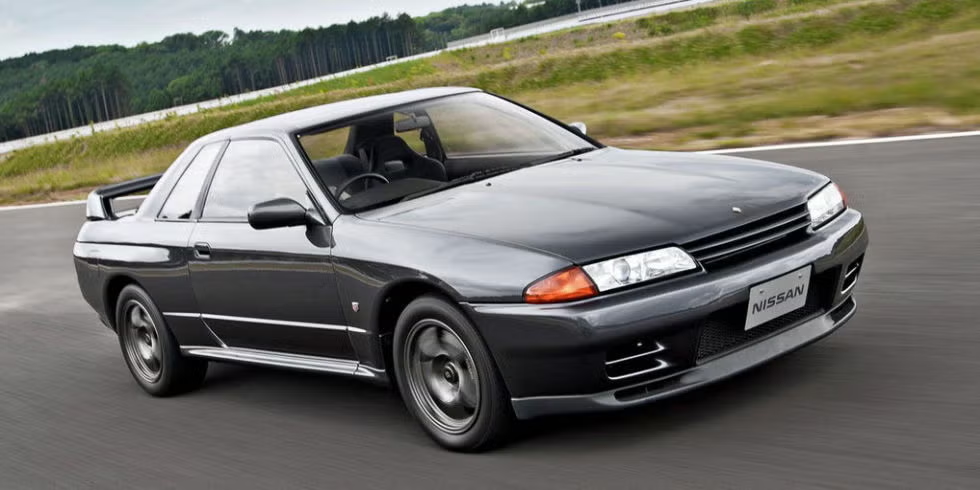
In August 1989, Nissan put the GT-R badge back on a Skyline after a sixteen-year hiatus. Within a few seasons, it was dominating so much that Australia changed its racing rules just to slow it down.
It won all 29 Group A races it entered in Japan. Then Australia added weight and cut its power by roughly 190 bhp.

A road car built to race
The road-going R32 GT-R existed mainly so that a race car could. Nissan had its eyes set on dominating Group A touring cars, and the rules demanded at least 5,000 road cars built within twelve months. The Japanese manufacturer’s application was approved on 1 March 1990. The company expected to build little more than that, but demand kept the car in production for more than five years: 43,937 in all.
The rulebook shaped the engine too. An early test engine was a 2.4 litre twin-turbo six, but a turbo engine of that size would have landed in a class limiting tyres to 10 inches wide. Nissan enlarged it to 2,568 cc, which moved it into a class that allowed 11-inch tyres, and the RB26DETT was born. Add ATTESA E-TS all-wheel drive, which runs mostly rear-driven and sends torque forward when the rear tyres slip, and Super HICAS rear-wheel steering, and the car had a grip advantage that rivals struggled to answer.

Unstoppable performance
In the Japanese Touring Car Championship, the GT-R won all 29 races it entered between 1990 and 1993 and took four straight titles. It won the 1991 Spa 24 Hours outright and went 50 for 50 in Japan’s N1 endurance series between 1991 and 1997. Then it went to Australia.
In 1989, Australia’s Wheels magazine nicknamed the GTR “Godzilla” and put it on its July cover with a headline saying Nissan’s new Godzilla aimed to slay the Sierra, before the car had raced there. Jim Richards and Mark Skaife won the 1991 Bathurst 1000 from pole, a lap clear of the second-place Holden, in a time of 6:19:14.8 that stood as the race record until 2010. They won again, just as convincingly in 1992. The R32 GTR earned its Godzilla reputation and the name stuck to every GT-R that followed.
See the full specs and figures of the Nissan Skyline GT-R R32 here.

The rule change
After Gibson Motorsport’s GT-Rs won in 1991 and 1992, the Australian sanctioning body raised the minimum weight by 140 kg to 1,500 kg and required pop-off valves that limited boost. Power fell from about 640 bhp to roughly 450 bhp. Group A ended in Australia after the 1992 season.
The official road car figure was 276 hp, because Japanese makers had informally agreed to cap advertised power. One technical appraisal puts the real number nearer 313 hp. Best Motoring timed an R32 at 8:22.38 around the Nürburgring Nordschleife in 1989, and in 2020 a heavily modified one ran the quarter mile in 6.47 seconds at 219.94 mph in Australia.
Fast Fact
- Did you know
Only 560 Nismo homologation cars were built, 60 of them earmarked for racing, and the N1 run totaled 245 (118 standard, 64 V-Spec and 63 V-Spec II).
supercarnostalgia.com

Godzilla’s slow start in Australia
The Australian chapter didn’t begin with a win. Mark Skaife drove the first GT-R at Mallala in June 1990, while Jim Richards stayed in the older GTS-R because he was chasing the championship and the team didn’t want to risk it. Only a broken hub stopped Skaife winning on debut. At Bathurst that October, the GT-R qualified 11th, and the conditions at Mount Panorama got the better of it.
By 1991 it was a different story. Before Australia’s rule makers added weight and restricted boost, the GT-R won nine of 11 events. Skaife later said that by the end of Group A the GT-R was far and away the best car of its kind.
Its last Australian race was the 1992 Bathurst 1000, and it ended in controversy. The race was red-flagged on lap 145 of 161 in the wet after several crashes, including one involving the leading GT-R of Skaife and Richards.
What it is worth now
The R32 was never officially sold in the United States and is now import-eligible there under the 25-year rule. It is the most modest riser of the three Skylines of its era: the later R34 has multiplied far more. Condition, originality, and the rarer variants (the Nismo, the N1 and the V-Spec cars) are what separate the top end from the rest.
Then versus now
4,445,000 yen at launch in August 1989 (gtrusablog), converted at the 1989 average of 137.97 yen per dollar (FRED/OECD). CLASSIC.com benchmark (about $56k) and an Aug 2026 sale at $47k, via a Sep 2026 import-guide roundup. Not adjusted for inflation. A guide, not a valuation.
If you are weighing the three generations against each other, you can compare the R32, R33, and R34 side by side.
See the full Nissan Skyline GT-R BNR32 page: specs, value and more

Leave a Reply